


Top 10 Most Expensive BMW Cars In The World: Ranked by Price, Power, and Prestige
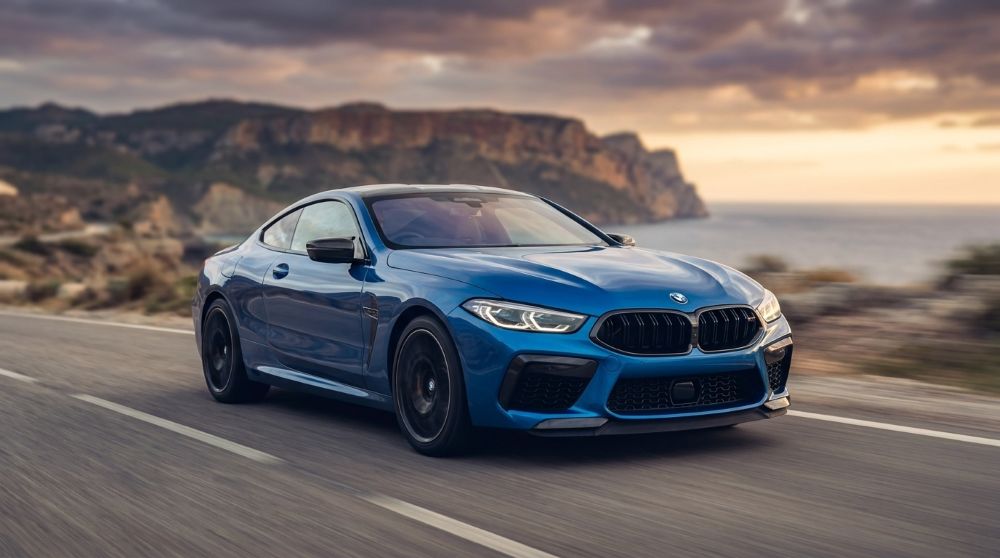
When it comes to luxury performance vehicles, BMW has consistently produced some of the most coveted automobiles ever built. The top 10 most expensive BMW cars in the world range from limited-edition supercars to hand-built collector pieces, with price tags that stretch from hundreds of thousands into the tens of millions of dollars.
Table of Contents
Key Takeaways
- BMW’s most expensive cars are defined by extreme rarity, motorsport heritage, and hand-built construction rather than standard production specs alone.
- Several of the priciest BMWs were never sold to the public originally and only appeared at auction decades later at enormous valuations.
- The BMW Art Cars and M-series race variants consistently attract the highest collector interest in the United States and globally.
- Limited-edition hypercars like the BMW M1 and the i8 Roadster Final Edition blur the line between road car and museum piece.
- At Father & Son Auto Sales, buyers who appreciate premium engineering can explore quality pre-owned BMW options without paying collector-car premiums.
- Understanding what drives BMW’s top valuations helps you make smarter decisions across any price point.
What Makes a BMW Worth Millions
BMW, or Bayerische Motoren Werke, has been engineering performance vehicles since 1916. While most shoppers associate the brand with accessible luxury sedans and SUVs, the company has also produced a small number of extraordinary vehicles that sit at a completely different level of desirability.
Several factors push certain BMW models into the stratosphere of collectible car pricing:
- Motorsport heritage: Cars with direct connections to Formula 1, Le Mans, or the DTM racing series carry enormous prestige with collectors.
- Production numbers: When fewer than 100 units of a model exist globally, scarcity alone inflates value dramatically.
- Art and collaboration: BMW’s Art Car program, launched in 1975, has seen legendary artists like Andy Warhol and Roy Lichtenstein transform production vehicles into rolling canvases worth millions.
- Technological firsts: Models that introduced breakthrough engineering, such as carbon fiber passenger cells or hybrid powertrains in a supercar context, hold lasting historical importance.
- Auction provenance: Many of the highest BMW valuations are established at major auction houses, where competitive bidding among serious collectors drives prices far above original retail.
Understanding these factors is essential before reviewing the ranked list below.
The Full Ranked List: BMW's Most Expensive Models
The following table summarizes the top 10 most expensive BMW cars in the world, organized by approximate market valuation. Note that auction results and private sale prices can vary, and some figures represent the highest known sale prices on record.
Rank | Model | Approximate Value |
1 | BMW 3.0 CSL “Batmobile” Art Car (Calder) | $30M+ |
2 | BMW M1 Art Car (Warhol) | $20M+ |
3 | BMW M1 Procar Race Car | $1.5M – $2M+ |
4 | BMW 507 Roadster (1956-1959) | $1M – $5M+ |
5 | BMW 328 Mille Miglia Touring Coupe | $750K – $2M+ |
6 | BMW M3 GTR (Road Version) | $500K – $750K |
7 | BMW Z8 Alpina | $300K – $500K |
8 | BMW i8 Roadster Final Edition | $200K – $300K |
9 | BMW M3 CSL (E46) | $150K – $250K |
10 | BMW M5 CS (F90) | $120K – $180K |
Values above reflect documented auction results and known private sales rather than manufacturer list prices, which have long since become irrelevant for most of these models.
A Closer Look at the Top Three
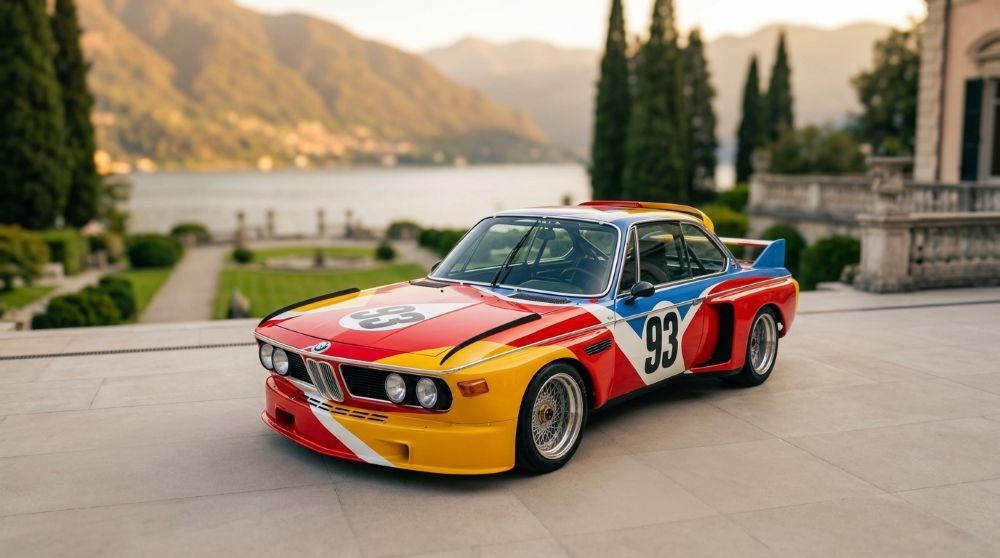
BMW 3.0 CSL Art Car by Alexander Calder
The most valuable BMW ever documented at auction is the 1975 Art Car created by sculptor Alexander Calder. Calder, known for his large-scale mobiles and abstract sculptures, painted the 3.0 CSL in a riot of primary colors before it raced at Le Mans. The combination of motorsport history, artistic provenance, and extreme rarity places its estimated value well above $30 million. For context, the entire Art Car series is considered one of the most significant intersections of fine art and automotive engineering in history.
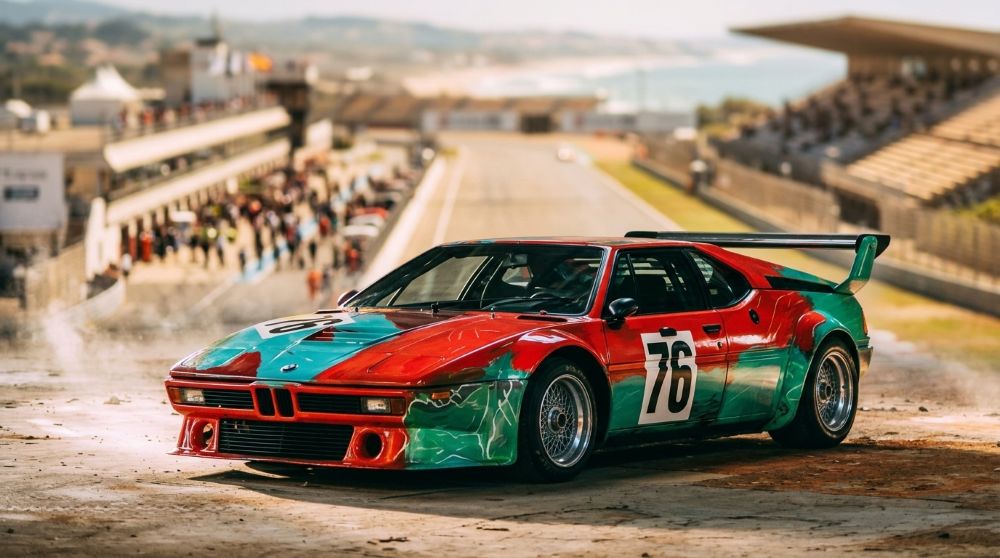
BMW M1 Art Car by Andy Warhol
Few names carry as much weight in American art as Andy Warhol, and his 1979 contribution to the BMW Art Car series produced one of the most recognizable race cars ever created. Warhol reportedly painted his M1 entry in under 30 minutes, applying vivid streaks of color intended to simulate speed visually. The underlying car, the M1, was itself BMW’s first mid-engined supercar, giving the Warhol piece double significance as both art and automotive milestone. Estimates for this vehicle consistently exceed $20 million. You can learn more about the full Art Car series at the BMW Art Car official archive.
BMW M1 Procar Race Car
The road-going M1 was remarkable, but the Procar variant built specifically for the BMW Procar Championship between 1979 and 1980 represents the closest BMW ever came to a purpose-built Formula 1 support series racer. Driven by legends including Niki Lauda and Nelson Piquet, authenticated Procar chassis regularly achieve prices between $1.5 million and $2 million or more at specialist auctions.
How Rarity and Racing Heritage Drive BMW Prices
One consistent theme across all entries in the top 10 most expensive BMW cars in the world is the connection between racing history and collector value. The BMW Museum in Munich documents this lineage extensively, but American collectors at auctions like Mecum and Barrett-Jackson have driven competitive bidding for these cars domestically as well.
Consider the BMW 507 Roadster. Originally produced between 1956 and 1959 in a run of just 252 units, the 507 was designed to attract American buyers but was priced too high at launch to sell well. Today that scarcity, combined with a design widely considered one of the most beautiful of the postwar era, pushes authenticated examples into the seven-figure range. Elvis Presley famously owned a BMW 507 during his time stationed in Germany with the U.S. Army, a piece of provenance that adds further cultural weight to the model.
The BMW 328 Mille Miglia Touring Coupe follows a similar trajectory. Built in the late 1930s specifically for endurance racing, only a handful of the lightweight Touring Coupe body variants were ever constructed. Their performance was sensational for the era, and surviving examples are treated as pre-war motorsport relics of the highest order.
For more modern entries on the list, the story shifts from pure rarity to technological exclusivity. The M3 GTR road version was produced in a run so small that many industry observers consider it one of the most thinly produced BMWs ever offered for retail sale. Its V8 engine, derived directly from the race car that won the American Le Mans Series in 2001, gave it a specification unlike anything else BMW offered at the time.
What Buyers Actually Get for the Price
It is easy to look at these valuations and assume the cars justify their prices purely on performance metrics. In some cases, they do. The BMW M5 CS, for instance, produces around 627 horsepower and accelerates from 0 to 60 mph in approximately 2.9 seconds, making it genuinely one of the fastest production sedans ever built. You can find detailed technical specifications at BMW North America’s official site.
But for the cars in the top half of the list, performance is only part of the equation. What buyers are really paying for includes:
- Historical documentation: Full paper trails proving race history, ownership chains, and restoration accuracy.
- Cultural significance: A Warhol or Calder connection places the car within fine art collecting as much as automotive collecting.
- Investment potential: Certain collector BMWs have appreciated faster than many traditional financial assets over the past two decades, though past performance never guarantees future returns.
- Exclusivity of ownership: For ultra-high-net-worth individuals, owning one of 10 or 20 surviving examples of a vehicle is a status signal that no modern production car can replicate.
The Hagerty Price Guide, which tracks collector car valuations across the United States, provides useful market context for anyone researching where specific BMW models sit in the current collectible market.
For buyers who want BMW’s engineering and brand prestige without collector-car pricing, the gap between these stratospheric figures and the real-world used market is enormous, and that gap is exactly where smart shoppers find opportunity.
YOU MAY ALSO LIKE: Top 10 Most Expensive Toyota Cars You’ll Ever See
Finding a BMW That Fits Your Budget
Not every BMW buyer has a seven-figure budget, and the overwhelming majority of the market operates in a very different range. The collector pieces covered above represent the absolute ceiling of what the brand has produced, but BMW’s everyday lineup, including the 3 Series, 5 Series, X5, and M-badged variants, continues to deliver exceptional driving dynamics and build quality across a wide range of price points.
At Father & Son Auto Sales, buyers who appreciate premium engineering can browse a rotating inventory of pre-owned vehicles, including quality used BMWs that deliver a genuine driving experience without the provenance premium attached to collector models. Whether you are drawn to the brand after researching the top 10 most expensive BMW cars in the world or simply looking for a well-maintained daily driver, working with a trusted used car dealer makes a significant difference in getting fair value.
Father & Son Auto Sales operates as a family-oriented dealership focused on connecting buyers with quality pre-owned vehicles. The team understands that most shoppers are looking for reliability, value, and transparency rather than auction-house drama. That straightforward approach is what sets a good neighborhood dealer apart from larger, impersonal operations.
If BMW is on your shortlist, it is worth understanding the full spectrum of what the brand produces, from the Warhol M1 that commands prices most people associate with fine art to the used 5 Series that delivers a genuinely satisfying commute. Knowing what the brand is capable of at its peak gives you a better appreciation for what you get at any price point.
For buyers in the United States researching vehicle history before purchase, the National Motor Vehicle Title Information System (NMVTIS) provides official title and history reports that help confirm a car’s background before you commit to a deal.
Frequently Asked Questions
What is the single most expensive BMW car ever sold?
The most expensive BMW ever sold is the 1975 Alexander Calder Art Car based on the 3.0 CSL, with an estimated value exceeding $30 million.
The car’s extraordinary value comes from two converging factors: its direct participation in Le Mans racing and its transformation by one of the twentieth century’s most celebrated sculptors. Unlike standard collector cars priced on mechanical rarity alone, the Calder Art Car sits at the intersection of fine art and motorsport history, which places it in a category that appeals to both automotive collectors and fine art institutions. No other BMW has come close to matching its documented valuation.
Are any of the top 10 most expensive BMW cars in the world street legal?
Yes, several of the most valuable BMWs were originally built as road cars, including the BMW 507 Roadster, the Z8 Alpina, and the M3 GTR road version.
However, street legality does not necessarily mean these cars are practical to drive. Most surviving examples have been preserved or restored to concours condition, meaning their owners typically trailer them to shows rather than commute in them. The M3 GTR road version is a notable case: it was built to satisfy homologation rules for racing, which required a minimum number of road-legal units to be produced. Those street versions retained the race car’s V8 engine, making them genuinely extraordinary to drive but also extremely valuable to preserve.
How do BMW Art Cars get their valuations if they are not traditional production cars?
BMW Art Cars are valued using a combination of fine art appraisal methodology and collector car market analysis, because they qualify as significant works in both categories.
Major auction houses that handle fine art, including Christie’s and Sotheby’s, have assessed BMW Art Cars alongside traditional paintings and sculptures. The artist’s market significance, the car’s racing provenance, and its physical condition all factor into the final figure. Because the Art Cars were actually raced in competitive events, they carry authenticity that purely static art installations cannot claim. This dual identity as functional race car and exhibited artwork is what pushes valuations to levels that standard collector cars, regardless of rarity, rarely achieve.
Can I find a pre-owned BMW at a reasonable price despite these extreme collector valuations?
Absolutely. The collector market for rare and historic BMWs operates completely separately from the everyday used car market, and quality pre-owned BMWs remain accessible at a wide range of price points.
The gap between a $20 million Art Car and a well-maintained used 3 Series or X5 is enormous, and most buyers have no reason to engage with the collector tier at all. Working with a reputable used car dealer like Father & Son Auto Sales gives you access to inspected, reasonably priced pre-owned vehicles without the complexities of auction bidding, provenance verification, or collector insurance requirements. BMW’s engineering quality means that even older used models, when properly maintained, deliver a driving experience that justifies the brand’s reputation.
Why do some rare BMWs appreciate in value while others depreciate like standard used cars?
The key difference is whether a model has the combination of limited production numbers, documented motorsport or cultural history, and sustained collector demand over time.
A standard 3 Series, regardless of how well it is maintained, depreciates because thousands of identical examples exist and it carries no unique historical significance. By contrast, a BMW M1 Procar with verified race history and a documented ownership chain represents something that cannot be replicated or produced again. Scarcity is necessary but not sufficient on its own; the vehicle also needs a compelling story that resonates with collectors. Models that tick both boxes tend to appreciate, while limited editions produced purely for marketing purposes often behave more like standard used cars once the initial novelty fades.
The Bottom Line on the Top 10 Most Expensive BMW Cars In The World
Reviewing the full spectrum of BMW’s most valuable vehicles reveals something important: the brand’s prestige is not built on marketing alone. From the Calder Art Car’s $30 million valuation to the M5 CS’s six-figure price tag, every entry on this list earned its position through genuine engineering ambition, cultural significance, or motorsport achievement. BMW has created machines that collectors and enthusiasts across the United States and beyond consider irreplaceable, and that sustained desirability is what separates the brand from most of its competitors.
If this ranking has deepened your appreciation for what BMW is capable of building, the next step is figuring out where you fit in that story. You do not need a collector’s budget to enjoy what the brand offers. Visit Father & Son Auto Sales to explore current pre-owned inventory and talk with a team that understands both the value of premium vehicles and the importance of finding the right fit for your lifestyle and budget.